
In response to an Environmental Information Request this week (EIR24031), South West Water’s Head of Legal Compliance provided detailed impact studies of the new Long Sea Outfall pipe being installed off Sandy Bay / Straight Point.
This outfall discharges treated effluent from our region’s only sewage treatment works (STW), but also acts as a storm overflow for untreated sewage when the treatment works cannot cope (normally after rain). Maer Lane STW processes all the sewage from Exmouth and Budleigh and the surrounding area, ‘fed’ by a network of pumping stations like Budleigh’s Lime Kiln pumping station. Any sewage going into any of our rivers or sea which has NOT been through Maer Lane STW is, by definition, untreated.
The sewage infrastructure around Exmouth has been failing for some time, with regular discharges going in to the Exe Estuary, even with small amounts of rain. The Exe is also home to our only two officially designated shellfish waters – which means they are subject to additional protections.
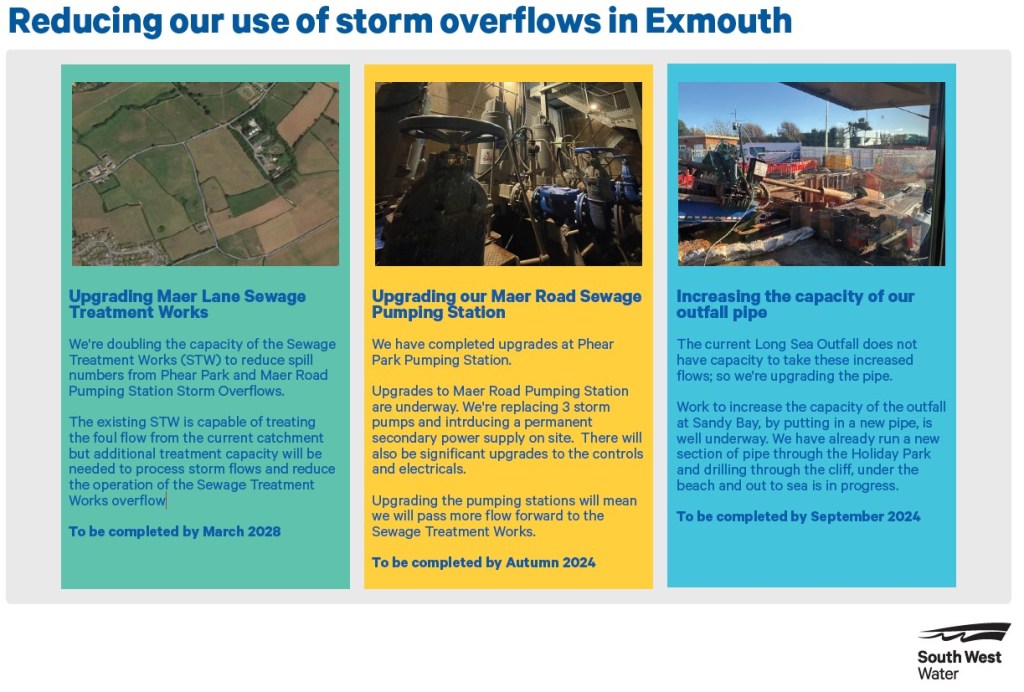
The extract below is from South West Water’s 2024 Exmouth roadshow, detailing their plan to reduce the sewage overflows into the Exe estuary.

So, the plan is to “move the spills from the Exe Estuary to the Sewage Treatment Works outfall”. To do that they are increasing the capacity of the pumping station and pipes from both Phear Park and Maer Road pumping stations (see the map above) – pumping this sewage up to the Sewage Treatment Works (STW). So that extra volume of sewage will be arriving at the STW during periods of rainfall, from Autumn 2024.
However, this treatment works already fails to cope with what it receives during any rain, dumping 1,200 hours of untreated sewage into the sea in 2023 alone. SWW acknowledge this in their flyer below, stating: “additional treatment capacity will be needed to process storm flows and reduce the operation of the Sewage Treatment Works overflow” (ie: untreated sewage dumps).
SWW have an ambition to upgrade these treatment works in 2028, but they currently appear to have no funding approved, no specific designs, and no land to build this on. There is certainly no guarantee that this timing will be achieved.
Critical question then: when all of this additional load arrives at Maer Lane STW, from Autumn 2024, what will happen to the excess, untreated, sewage?
SWW are clear: “The current Long Sea Outfall does not have capacity to take these increased flows; so we’re upgrading the pipe.
Work to increase the capacity of the outfall at Sandy Bay, by putting in a new pipe, is well underway. To be completed by September 2024
In the response to the EIR, they state the max capacity of this new pipe is 990 litres / second.
SWW state that, until the STW are updated in 2028, nearly three quarters (72.5%) of all the liquid being pumped down the pipe will be untreated (‘storm water’), and only 27% will be treated effluent from the treatment works. Even after any upgrade works to the treatment works (2028+), 45% of the outflow from this pipe will be untreated sewage.
In figures just released for 2023, Maer Lane STW discharged untreated sewage through the old storm overflow 83 times, for a total of 1,200 hours. Maer Road pumping station discharged 74 times for 883 hours, and Phear Park pumping station 31 times for 231 hours. A total of 188 untreated sewage discharge occasions (so about one every second day) for 2,300 hours.
As we have seen, SWW’s plan is to move as much of these spills as they can through the new, upgraded outfall pipe, just off Straight Point.
Due to this significant increase in volume, we requested specific, detailed information on what modelling had been done on where this untreated sewage will go after it’s released from the pipe. SWW responded by saying that their modelling showed no impact on the Exe Estuary or towns to the East of the Exe.
However, they did state that modelling showed an impact on Budleigh Salterton: “given the increase in storm volumes and the fact the modelled plume was shown to impact the (Budleigh Salterton) bathing water under certain conditions.”
Only a single scenario was modelled in SWWs response, which clearly shows how a discharge at straight point, with prevailing winds and currents, does push an E-coli plume directly for Budleigh’s western beach, passing Eastwards, right along the shore line. This modelling also reflects very much what we experience when regularly kayaking from Budleigh up to Straight Point and back.

For context, The yellow cross top right, is just about where the Longboat Cafe is situated, with Steamer Steps to the West.
Although it’s difficult to relate these modelled E-coli concentrations to the legal safety limits, it’s clear that the yellows, oranges and red colours are at the highest end of the concentration scale, and that this e-coli plume comes both close to the beach just around Steamer Steps, with the current pushing this right along towards Lime Kiln.
SWW’s response to our FOI includes this statement: “A statistical check was required to evidence no deterioration at Budleigh Salterton given the increase in storm volumes and the fact the modelled plume was shown to impact the bathing water under certain conditions. It was concluded that statistically the increase in storm volumes coming from the Straight Point outfall will have a negligible impact on bathing water quality at Budleigh Salterton Bathing Water.”
This statement appears contradictory. The modelling “shows there is an impact” – yet the increased sewage discharged “will have negligible impact”.
It’s also worth mentioning (again), that SWW only count the ‘beach’ as being the section by the Longboat Cafe (which in this instance is some way further East of the main plume concentration). What about modelling the E-coli concentrations off Steamer Steps, where the vast majority of Budleigh’s local swimmers are active all year round?
What are we asking for?
This ‘plan’ aims to concentrate sewage overflows into the sea off Straight Point. The upshot of that – as their own modelling shows – is to risk pushing “a plume of e-coli towards Budleigh”. This situation may improve sometime after 2028, but there are no guarantees on the timing or the effectiveness of any work there – and it’s at least 4 years away.
There is a danger that SWW see this plan as a way to reduce their operating costs over the next four years, by dumping huge volumes of untreated sewage into our beach area. We need them to understand that this is not a free-pass, and that they need to do whatever is necessary to treat the max possible sewage, and discharge only as an emergency valve.
The response from South West Water raises as many questions as it provides answers. What are the modelling plots for all states of tide and conditions? How regularly will the plume spill out towards Budleigh beach (it certainly seems the prevailing current when we are kayaking in that area)? Does the modelling take account of the actual level of sewage dumps (eg: 2023 values), rather than SWW’s ‘aspirational’ spill targets’? We need proper assurances – and for South West Water to agree actions to mitigate this harm.
It would also be great to see SWW investing in infrastructure which actually properly collects and treats our sewage, rather than large capital projects (Lime Kiln CSO pipeline, Sandy Bay / Straight Point pipeline) whose aim is just to more effectively discharge increasing amounts of untreated sewage into our seas.

 Budleigh Sewage action
Leave a reply to SWW “improvement plan” sends concentrated E-coli plume heading for Budleigh’s beaches from Autumn 2024 for at least four years | East Devon Watch Cancel reply