

One of the most frequent questions we hear is “Is it safe to swim off the beach at Budleigh?” In this post, we’ll take a look at the water quality data, and offer some guidance on how best to check before you swim – Summer and Winter. Note: we are not providing advice on whether it is safe for anyone to swim on any given day!
Firstly, it’s the role of the Environment Agency (not South West Water), to regularly test bathing water during the Summer months, and to categorise all designated bathing beaches from the results. In particular, each sample is tested for the levels of E-Coli and Enterococci present in the water. High levels of these bacteria in bathing water can – and do – cause sickness and diarrhoea to swimmers and other beach users, so there are defined thresholds, above which, bathing is ‘Not Advised’.
At the end of each bathing season, the EA look back over all the samples taken in the last 4 years and, depending on the % of samples tested which are worse than the POOR level, the beach is assigned a star rating of Excellent, Good, Sufficient or Poor. Budleigh currently has an ‘Excellent’ rating, though as can be seen in the chart below, we are very close to slipping down into the ‘Good’ category.

It’s probably important to consider that the water rating is more a measure of how many bad water days we get, rather than the cleanliness of the water on the majority of ‘normal’ days. This may reassure some swimmers who worry that the water may always be quite polluted.
We can do that by analysing the results of the EA water samples taken, and seeing the bacteria concentration levels of each of the 63 samples taken over the last four years, from very cleanest (left hand side of chart below), through pretty toxic (right hand side).
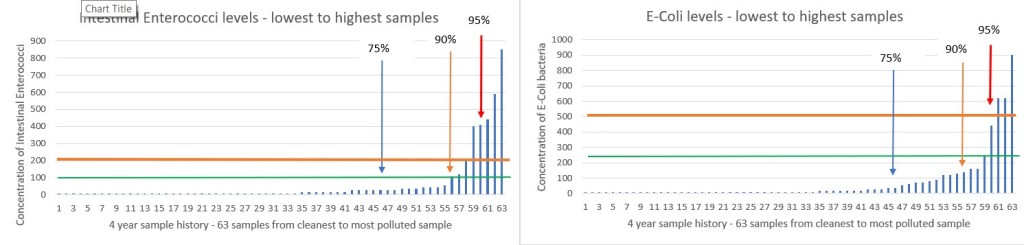
Below Green line shows water is EXCELLENT, but above Orange line – water quality is POOR
This clearly shows that the water really is pretty clean on around 80% of days in the May-Sept period, BUT it also shows just how highly polluted the water can get (up to 3 times worse than the ‘Poor’ level) after incidents of pollution or high rainfall.
So how do the EA sample Budleigh’s bathing water?
- Critically the EA only sample the water in the Summer ‘swimming season’, from May to September. This is a major issue for us – as many Budleigh folk swim all year round. This is a national issue, but with more and more people swimming all year round, it’s important that we campaign to see how this can be changed
- The Environment Agency aim to sample the bathing water 20 times in the season, so about once per week. Testing water quality is not quick, so results of each test are not available for several days after sampling. This means that we cannot check the current actual water quality on the EA web site. The main purpose of this sampling appears therefore to determine the next year’s water quality rating, as well as to identify any major issues
- To try and resolve that, the EA run a computer analysis every morning during the bathing season, to forecast the likely pollution level at the beach that day. This results in a straight ‘OK’ or ‘Bathing not Advised’ status. This status is displayed at Steamer steps, on the electronic board near the Longboat Cafe, and online via the LoveBudleigh web site. During the season, this should give the most accurate forecast on swimming conditions.
- During the 2023 season, there were 16 days when the EA declared ‘Bathing not Advised’
The chart below shows how the 2023 daily forecasts compare with the subsequent water quality measured from the samples. For each day of the season, RED in the first column identifies any days when the EA declared a Pollution Risk forecast. BLUE in the second column shows the 20 days when a water sample was taken, and Red or Amber in the third column shows if any of those samples were subsequently found to be POOR.
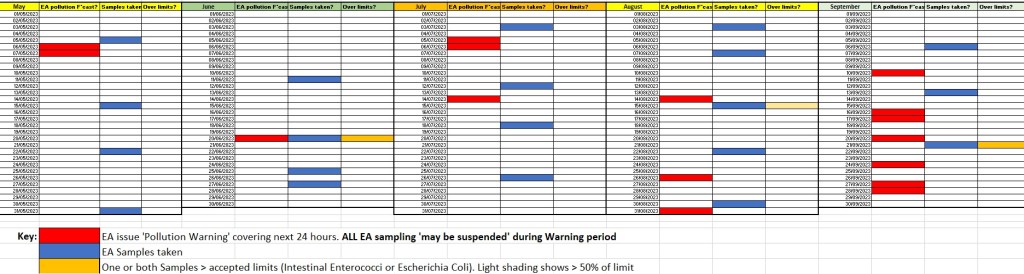
What this shows is that whenever the EA sampled the water within 48 hours after an EA declared ‘Pollution Risk’ day, the subsequent sample showed E-coli or Enterococci levels close to or greater than POOR levels.
This suggests that the water may not have been fit for swimming on around 30 days in the 150-day sampling season. That’s about 20% of time. That’s appears worse than the ‘Excellent’ rating would indicate.
One possible reason why our figures look worse than the official rating, is IF the EA suspend normal sampling if a Pollution Forecast is active. Although this possibility would appear to make a mockery of the whole sampling process (as they would only then sample the water when they were pretty sure it was ‘clean’!), there does seem to be scope for them to do this within the regulations. Looking at the pattern of testing days in the chart above, there are a couple of occasions when the sampling pattern suggests that this could have happened. To find out IF the EA have ever suspended or changed the sampling dates, we’ve raised an Information Request on EA to ask that question.
What the sampling results do show is that the Pollution Forecasting system appears to be a good indicator of when not to swim – but perhaps prudent to wait 48 hours before going back in after a Warning, rather than just 24 hours.
So during the bathing season, the EA Pollution Forecast, via the LoveBudleigh web site, is probably the best indicator of whether it’s safe to swim. But what about the other 7 months of our swimming year?
The most useful tool outside of the season is probably the Surfers Against Sewage app, SSRS. This takes input from all of the local sewage overflow sensors, and it produces an alert for the beach IF any of these sewage overflows registers a prolonged discharge (the actual time threshold is specific to each sewage overflow point). It’s also of note that there appear to be significantly more sewage discharges by South West Water outside of the sampled bathing season.
What SSRS does not take into account is any agricultural pollution coming in from the River Otter, which is a significant contributor to the water quality. That’s why we want the EA to extend their pollution forecasting and water sampling to all year round. In the meantime, do download and use the ‘SSRS’ app, for all ‘out of season’ swimming. However, it’s probably also prudent to avoid times when the river has been particularly high after heavy rain – and certainly avoid the area by the river mouth and brook outfalls.
Next time, we’ll take a look at where on the beach the Environment Agency take their samples, and why this might either under- or over-estimate the cleanliness of the water – depending on where you decide to swim.

 Budleigh Sewage action
Leave a comment